(function(w,d,s,l,i){w[l]=w[l]||[];w[l].push({'gtm.start': new Date().getTime(),event:'gtm.js'});var f=d.getElementsByTagName(s)[0], j=d.createElement(s),dl=l!='dataLayer'?'&l='+l:'';j.async=true;j.data-privacy-src= 'https://www.googletagmanager.com/gtm.js?id='+i+dl;f.parentNode.insertBefore(j,f); })(window,document,'script','dataLayer','GTM-MF9T2HG');

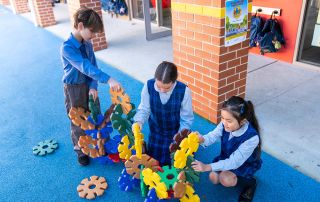
Protecting Childhood Through Play

At Sydney Catholic Schools, play is recognised as an important part of educating the whole child, supporting students’ academic, social, emotional, physical and spiritual growth while helping them develop the confidence, resilience and skills needed to flourish. 

From imaginative learning in the early years to sport, creative arts, collaborative problem-solving and outdoor experiences, play encourages curiosity, creativity, resilience and a sense of belonging.  

Sydney Catholic Schools Specialist: Early Years (Pre K–Year 4), Curriculum and Innovation, Kim Moroney says these experiences help students engage with the world around them while fostering the relationships and wellbeing that underpin successful learning. 

“The science is clear: in just 30 minutes of play, one third of the neurons in a child’s brain are changed,” she said.

“Play literally grows brains, and it builds the resilience, creativity, empathy and physical health that children carry with them for life.”

Under Article 31 of the United Nations Convention on the Rights of the Child, which Australia ratified more than 35 years ago, every child has the right to play, rest and leisure. Yet according to Play Australia, one in three children is not getting the play they need, with childhood increasingly shaped by overcrowded schedules, screen time and shrinking spaces. 

Reflecting on the theme Protect play, protect childhood for this year’s International Day of Play, Ms Moroney said beyond its benefits, play holds a deeper truth: it is a right, and it is an expression of freedom.  

“Every moment of play is filled with meaning. It shapes learning and development, sparks creativity and strengthens wellbeing,” she said.

“In play, children are authors of their own stories, free to explore, invent and connect. When we protect play, we protect a future where childhood is honoured, valued and full of possibility.”

By protecting play, Sydney Catholic Schools helps protect childhood, reflecting our enduring commitment to nurturing every student in body, mind and spirit.  Read more: …
End of Era Functions Policy

“This policy is recognition of the fact that Sydney Catholic Schools (SCS) acknowledge Aboriginal and Torres Strait Islander peoples as the custodians of the lands upon which our schools stand. We pay our respects to Elders, past, present and future.

A new chapter in learning at St Mary’s Cathedral College Sydney

Looking for a school that evolves with its students—supporting, challenging, and inspiring them at every stage? At St Mary’s Cathedral College Sydney, this vision is now a reality.

In 2025, the College introduces a pioneering three-tier structure: Junior School (K-4), Middle School (5-8), and Senior School (9-12), ensuring a seamless transition between primary and secondary education.

“Responding to the demand for a more tailored educational experience, we’ve designed each school to meet the distinct needs of students as they progress,” says Principal Kerrie McDiarmid.

From foundational learning in Junior School to integration in Middle School and specialisation in Senior School, this approach ensures every student discovers their unique strengths and pathway.

St Mary’s Middle School redefines learning for Years 5 and 6, offering enriched experiences beyond the traditional primary curriculum. Dedicated teachers bridge primary and secondary education, fostering curiosity, confidence, and growth.

A key feature is its integrated learning model where subjects connect meaningfully, promoting cross-disciplinary thinking and real-world problem-solving. “Being in the heart of the city, we’ve partnered with institutions and businesses to enhance hands-on learning,” says David Timillero, Assistant Principal of the Middle School.

These partnerships give students direct access to industry professionals, collaborating with the Australian Museum, the Art Gallery of NSW, and Sydney FC, among others. The College is also launching a biophilic design project with Vertikal and the University of NSW.

Complementing this structure is the College’s renowned Phronesis Program, developing wisdom, reasoning, and ethical decision-making. The Liberal Arts approach encourages critical thinking across disciplines, ensuring students excel academically while building character and celebrating their Catholic faith.

This transformation aligns with the curriculum …

Prevention and Management of Student Bullying Policy

Type: Policy
Classification: Operational
Policy Number: SCS2023001
Released: 27 January 2023
Review Date: 27 January 2026
Rescinds/Replaces: TL201604-1.1

Sydney Catholic Schools (SCS) is committed to providing a respectful, safe and supportive learning environment for students. Bullying undermines the dignity and wellbeing of each student, and SCS considers all forms of bullying behaviour unacceptable. In line with its values, SCS fosters communities of care where every student is known, valued and supported through cura personalis, promoting their holistic growth and wellbeing.

Bullying is intentional and repeated behaviour that involves the ongoing misuse of power that can cause physical and/or psychological harm to a student. Bullying behaviour can be verbal, physical, social (e.g. excluding, alienating behaviour) and psychological (spreading rumours, sending hurtful messages or comments) and includes bullying via social media and other online platforms (cyber-bullying).

Bullying can involve discrimination, intimidation and harassment. Bullying behaviours may be individual or collective behaviours which occur on or outside school premises and during or after school hours. Some bullying may constitute criminal conduct such as assault, threatening behaviours, property damage or harassment and stalking.

The purpose of this policy is to support SCS school communities to prevent and address issues of student bullying to build respectful relationships. SCS staff will work in partnership with parents and carers who have an integral role to play in the prevention and resolution of bullying. Through a shared commitment to service and the integral formation of the whole person, this policy supports school communities to nurture safe, inclusive and respectful environments where every student can flourish and reach their full potential.

This policy applies to SCS staff, parents and carers. In this Policy SCS staff means all employees, members of religious orders engaged in schools, volunteers, trainees, interns, and labour hire employees.

Failure to comply with the responsibilities and obligations outlined in the policy may result …

March 29, 2016|

Bring Your Own Device (BYOD) Policy

Type: Policy
Classification: Operational
Policy Number: SCS2024021
Released: 1 May 2024
Review Date: 1 May 2026
Rescinds/Replaces: TL201806-1.0

Related Documents

ICT-BYO Device Requirements

Student Acceptable Use of Technology Agreement

Bring Your Own Device (BYOD), means that students bring to school personally owned devices for the purpose of learning.

The access to devices that a BYOD program provides, will assist students in developing digitalliteracy, fluency and citizenship while preparing them for the high-tech world in which they will live, learn and work. It will have the potential to empower students by giving them a voice in the
decision making process of how they use technology in their own learning.

It will also allow teachers to continue to employ technology in the classroom while building on the experiences gained in the previously government-supported Digital Education Revolution (DER) model (2008).

This policy applies to all SCS staff, students and parents/carers. In this policy staff means all employees of SCS, members of religious orders engaged in schools, volunteers, trainees, interns and labour hire employees.

The following principles guide how this policy will operate in practice:

3.1 Equity and access to technology should be provided for all SCS students.

3.2 SCS schools will endeavor to provide a safe and secure online environment for all learning activities.

3.3 The integration of ICT is to support and enhance contemporary, authentic learning in SCS schools.

3.4 No students should be disadvantaged by a local community’s decision to move to a BYOD model.

  • Schools will, through consultation with their communities, allow students to bring personally owned digital devices to school for the purposes of learning.
  • Students can use a BYO Device only with the knowledge and written approval of their parent or caregiver. The return of the Student Acceptable Use of Technology Agreement constitutes such knowledge and approval.
  • Prior to implementing …
March 28, 2016|

Gifted Education Policy

Type: Policy
Classification: Operational
Policy Number: SCS2022008
Released: 14 March 2022
Review Date: 14 March 2025
Rescinds/Replaces: TL201401-1.1

Sydney Catholic Schools (SCS) is committed to supporting all students to achieve their educational potential and flourish through an education that nurtures the whole person. In alignment with the SCS Mission, Vision and Values and the aspirations of the Magis Strategy, this includes recognising gifted students’ advanced learning capacity and providing tailored learning opportunities that foster intellectual excellence, personal growth and the realisation of each student’s God-given potential.

The purpose of this policy is to provide direction on implementing effective learning and teaching practices to meet the needs of gifted students, ensuring high-quality Catholic education and talent development opportunities are accessible to all learners, enabling them to thrive and achieve excellence regardless of their circumstances.

The policy applies to all SCS staff. SCS staff means all employees, members of religious orders engaged in schools, volunteers, trainees, interns and labour hire employees.

Failure to comply with the responsibilities and obligations outlined in the policy may result in disciplinary action being taken, including termination of employment.

3.1 Giftedness is present in every culture, socio- economic context and a variety of domains.
3.2 All students have the right to receive an education that is responsive to their needs.
3.3 Effective school environments based upon quality teaching, learning and leadership are essential for helping all students achieve their potential.
3.4 The making of educational decisions regarding services and provisions for gifted students is the responsibility of schools and families.

Gagné’s definitions of giftedness and talent are established in the Differentiated Model of Giftedness and Talent DMGT (2020)
4.1 Giftedness designates the possession and use of untrained and spontaneously expressed outstanding natural abilities or aptitudes (called gifts), in at least one ability domain, to a degree that places an individual at least among the top 10% …

March 25, 2016|
Go to Top