(function(w,d,s,l,i){w[l]=w[l]||[];w[l].push({'gtm.start': new Date().getTime(),event:'gtm.js'});var f=d.getElementsByTagName(s)[0], j=d.createElement(s),dl=l!='dataLayer'?'&l='+l:'';j.async=true;j.data-privacy-src= 'https://www.googletagmanager.com/gtm.js?id='+i+dl;f.parentNode.insertBefore(j,f); })(window,document,'script','dataLayer','GTM-MF9T2HG');

Raising Readers in a Screen Age

Somewhere between bedtime stories and high school homework, many parents notice a shift: the child who once devoured books now seems glued to a screen. 

If that sounds familiar, you’re not alone. 

The teenage years are often when reading for pleasure starts to decline, replaced by social media, streaming, gaming and busy schedules. But staying connected to reading matters more than ever. It builds vocabulary, imagination, empathy, confidence and communication skills, while supporting learning across all subjects. 

The good news? Raising a reader doesn’t mean battling over books or banning screens. It’s about making reading feel enjoyable, relevant and part of everyday life. 

Why reading still matters more than ever 

Reading does far more than build literacy. It shapes how children think, learn and understand the world. 

Regular readers develop stronger vocabulary, comprehension and critical thinking skills, along with imagination, creativity and empathy. These benefits support stronger academic outcomes across all subjects. 

Reading also supports wellbeing. It gives young people space to slow down, step away from screens and become absorbed in stories in a way that is calming and restorative. 

Start early, but don’t stop there 

In the primary years, reading together helps build strong foundations. Sharing stories, asking questions (“What do you think happens next?”) and talking about characters keeps reading fun and engaging. 

But as children move into secondary school, reading habits can shift and many parents understandably step back. 

“Reading for pleasure often dips in the teenage years, but that doesn’t necessarily mean teens aren’t reading, perhaps just differently,” explains Adam Moore, Curriculum Specialist at Sydney Catholic Schools.  

“By tapping into pop culture, parents can help turn ‘I don’t like reading’ into ‘Wait, there is a book about that?’” 

Rather than focusing on whether your child has ‘done their reading’, connect books 


From scrolling to stories: Four ways to help teens fall in love with reading again

In today’s world of endless social media feeds, streaming services, and constant notifications, it’s easy for teenagers to forget the simple joy of getting lost in a good book. Nurturing a love of reading doesn’t have to be a chore, it can be a delightful journey back to wonder, imagination, and even faith.

If you’re a parent or guardian looking to gently reignite that spark, here are four practical ways to help your child rediscover the magic of reading.

Along for this literary ride are our resident Sydney Catholic Schools experts, Curriculum and Innovation Specialists Jacqueline Simpson and Adam Moore, who offer practical, research-informed insights into how teens engage with stories today.

Start with what they already love

Books don’t have to be classics or New York Times bestsellers to spark interest. If your teen is into Marvel, Minecraft, or The Mandalorian, there’s likely a novel, comic, or companion book to match.

“Reading for pleasure often dips in the teenage years, but that doesn’t necessarily mean teens aren’t reading, perhaps just differently,” explains Adam.

By tapping into pop culture, parents can help turn “I don’t like reading” into “Wait, there’s a book about that?”

📚 Recommended reads:

  • Star Wars: Ahsoka by E.K. Johnston – Fills in the story between the Clone Wars and Rebels with strong themes of courage, identity, and justice.
  • Minecraft: The Island by Max Brooks – A survival adventure written in a fun, accessible style that mirrors the game’s challenges.
  • Halo: The Fall of Reach by Eric Nylund – A deeper 


WriteOn 2022: Creativity spells success for budding student author

A story about an un-fun fair has secured a Sydney Catholic school student a win in the 2022 WriteOn Competition.

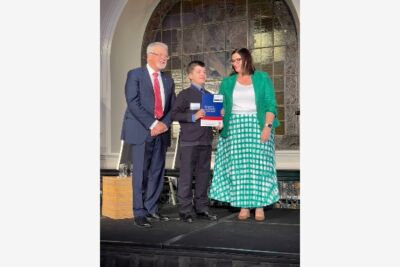
Holy Innocents’ Catholic Primary School student Samuel Phillips has been named a winner in the WriteOn competition for the second straight year, this time winning gold. Last year he won silver. 

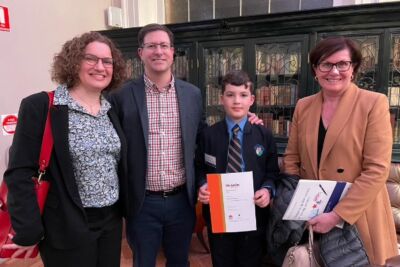
WriteOn 2022 winner Samuel from Sydney Catholic SchoolsBuoyed by his win, the school has now established an “Author’s Corner” in the school library where children who love to read and write can get together to share and discuss their ideas, projects and the latest books they’ve read.
“I wanted to get gold, so I tried again and I won!” – Samuel Phillips

Samuel’s gold medal-winning story will be included in the best of WriteOn 2022 anthology. 

An annual competition of the NSW Education Standards Authority (NESA), in conjunction with the State Library of NSW, WriteOn asks students in Years 1 to 6 to write a 500-word creative piece based on an image.

The write stuff

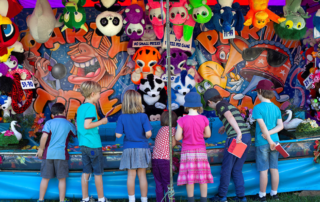
A photo of a fairground games stall (pictured above) was the inspiration for Samuel’s 2022 entry.

“I wrote about an un-fun fair,” Samuel, a Stage 2 student at Holy Innocents, explained.

WriteOn 2022 winner Samuel from Sydney Catholic Schools“There are seven kids and they go to a fun fair, where they all get picked off one by one.

“They then defeat the evil wizard, Zoron, and their friends come back.” 

Samuel accepted his award at the State Library from the NSW Education Minister, Sarah Mitchell, on 12 September.

Deborah Bestulic, Principal of Holy Innocents’ Catholic Primary School, couldn’t 


October 11, 2022|

Book club for parents: An excuse to connect and reflect

St Andrew’s Catholic Primary School Malabar’s book club for parents is made of the write stuff.

The book club was started in 2016 by the school’s then-Family Educator, Brenda Smith, to give parents a relaxed environment to connect with others.

It quickly became a social gathering where people who would normally not connect in the school yard could connect over a book. 

“It is always great to have commonality with others” –  Frances Addabbo

What happens in book club

St Andrew’s book club meets every six weeks to discuss a book chosen after mutual discussion.

Restaurant gatherings have turned into 40-minute Zoom sessions online while COVID-19 pandemic restrictions are in place.

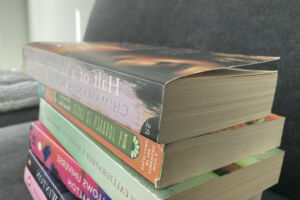
A pile of booksWhat are they reading?

The group will discuss Mexican author Sofia Segovia’s novel The Murmur of Bees at their next online meeting in September.

The novel is about the impact of an adopted boy, protected by bees and with the gift of foresight, on those around him. It is set during the Mexican revolution and influenza pandemic of 1918.

St Andrews’ current Family Educator, Frances Addabbo, who now facilitates the book club, chose the book based on the recommendation of a friend.

Why join

Ms Addabbo said the main highlight of the book club was a sense of connection between parents at the school.

“Parents have appreciated taking time off their schedule, family and work responsibilities to read a book,” she said.

This year St Andrew’s book club has also read WWII love story The Lace Weaver by Lauren Chater and Geraldine Brooks’ The Secret Chord, an exploration of the life of King David in the Bible’s Old 


Books for 5-8 Year Olds

My child is 5-8 years old. What should I look for when picking a book they will want to read? We asked Sydney Catholic Schools’ Education Officer: Reading Recovery, Rosemary Peric.

1. What should a parent/carer look for in a children’s book?

  • Interesting vocabulary with the unexpected use of language making the story exciting;
  • Stories with rhyme, rhythm or repetition;
  • A story with a ‘problem’ and then the joy of resolution;
  • A theme that interests the child; and
  • A story that makes the listener attuned to the detail of the language to be thinking, problem solving as the story is read, making meaning and 
 children saying: ‘Read it again! Read it again!’ when the book is finished.

2. What are the benefits of reading aloud to children at this age?

When you read to young children it:

  • Promotes a love of reading
  • Develops awareness of the sounds, rhythms and patterns of language
  • Builds vocabulary and a knowledge of book language
  • Develops skills in listening comprehension and critical thinking
  • Builds concentration
  • Encourages children to be imaginative
  • Promotes oral language development

Sydney Catholic Schools' Education Officer: Reading Recovery, Rosemary Peric Rosemary Peric. Photo: Kitty Beale

3. What is your best tip/s for encouraging a reluctant reader?

  • Read over and over again! Read stories that your child/ren love and read them with enthusiasm, don’t be dull, flat or boring, read with joy;
  • Visit your local library and allow your child to choose their own books;
  • Don’t worry if they want to read the same book more than once, just as a musician enjoys playing the same piece of music many times, so too a young reader can get something more from a book each time they read it;
  • Talk about the pictures and details that catch your child’s interest. 

December 22, 2020|

Just one more page . . .

COVID-19 won’t stop these little bookworms!

The kindergarten kids at St Gertrude’s Catholic Primary School Smithfield have been knee-deep in reading while in iso thanks in big part to two teachers at the school.

Kindy teachers Anique Giusti and Tania Caruana have curated a short instructional video for parents, to help parents to support their child’s reading development while cooped up at home.

The video includes a guided reading scenario and a number of strategies to help students decode texts and improve their reading comprehension – and, perhaps most importantly, make reading fun.

“The video has really helped us to know how to read with my daughter” – kindy parent, Dayana Kanoon

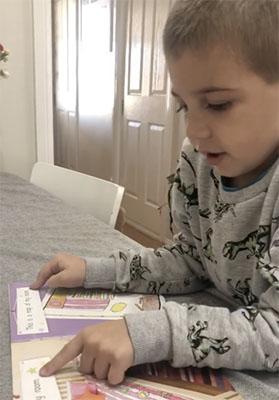
A St Gertrude's Catholic Primary School Smithfield kindy student identifies parts of the text to demonstrate her understanding of the content A St Gertrude’s kindy student identifies parts of the text.
The St Gertrude’s video has been a huge hit with grateful parents who say it’s been useful to have this learning-to-read tool to keep children reading, thinking – and growing.

“The video has really helped us to know how to read with my daughter,” kindy student Ariella Kanoon’s mother, Dayana Kanoon, said. “I have also shared it with my sister.”

School principal, Linda O’Regan, said the video project is just one fine example of the great things our teachers are doing to support families during the coronavirus.

“I’m really proud of the way our staff have worked collaboratively over this period, to adapt their talents and skills to support our community – a multicultural community, comprising students with diverse needs,” Mrs O’Regan said.

Sydney Catholic Schools' Director of Education and Research Dr Kate O'Brien Sydney Catholic Schools’ Director of Education and Research, Dr Kate O’Brien. Photo: Kitty Beale 


Go to Top