(function(w,d,s,l,i){w[l]=w[l]||[];w[l].push({'gtm.start': new Date().getTime(),event:'gtm.js'});var f=d.getElementsByTagName(s)[0], j=d.createElement(s),dl=l!='dataLayer'?'&l='+l:'';j.async=true;j.data-privacy-src= 'https://www.googletagmanager.com/gtm.js?id='+i+dl;f.parentNode.insertBefore(j,f); })(window,document,'script','dataLayer','GTM-MF9T2HG');

Targeted teaching drives strong NAPLAN gains across Sydney Catholic Schools

Targeted student support, evidence-informed professional learning and collaboration between schools are helping lift numeracy outcomes across Sydney Catholic Schools with exceptional NAPLAN results across the system. 

The results reveal the number of Sydney Catholic Schools students achieving NAPLAN’s Strong or Exceeding numeracy bands in 2026 grew by 846 compared with 2024.  

Year 7 recorded the strongest system-wide improvement in numeracy rising five percentage points, while Years 5 and 9 also made gains. The progress was even more pronounced when the same group of students was tracked from Year 5 in 2024 to Year 7 in 2026, with proficiency rising by almost nine percentage points. 

Sydney Catholic Schools Director of Education and Research Kevin Carragher said the results reflected a consistent, evidence-based approach to mathematics teaching. 

“Our teachers are applying research on how the brain learns through explicit instruction, clear modelling, regular review and carefully tailored support, building students’ confidence and ability to tackle increasingly complex mathematics,” Mr Kevin Carragher said. 

“This deliberate approach helps students build knowledge progressively and retain it over time. The gains we are seeing across different year levels and schools show what sustained, high-quality teaching can achieve.” 

Reading results also improved, with around 400 more Sydney Catholic Schools students achieving in the Strong or Exceeding bands than in 2024. 

Year 5 reading proficiency rose two percentage points to 86 per cent. Among matched students moving from Year 3 to Year 5, reading proficiency increased three points to 87 per cent. 

“These figures represent thousands of individual students strengthening the knowledge, skills and confidence they need for future learning,” Mr Carragher said. 

“I want to thank our teachers and school leaders for their expertise, professionalism and commitment to ensuring every student has the opportunity to make progress.” 

Key school insights – Primary schools 

St Joseph’s Catholic Primary School Belmore 

  • Students achieving Exceeding in …
Sydney Catholic Schools records strong growth in NAPLAN numeracy outcomes

Sydney Catholic Schools is celebrating strong growth in student numeracy achievement in the 2026 NAPLAN results, with a record proportion of students reaching the highest level of proficiency. 

Across the system, 80.9 per cent of students reached the proficiency standard in numeracy, up from 79.5 per cent in 2025, while the proportion of students achieving the highest ‘Exceeding’ level rose from 17.8 per cent to 20.1 per cent. 

The strongest gains were recorded in Years 5 and 7 while every year group showed growth at the top tier.  

Cohort tracking also demonstrated strong long-term progress. When following the same group of students from Year 3 in 2024 to Year 5 in 2026, overall proficiency climbed by 4 percentage points. 

Kevin Carragher, Sydney Catholic Schools Director of Education and Research said the results reflect sustained, system-wide work to strengthen mathematics teaching. 

“Behind every percentage point is a student growing in confidence, capability and a stronger belief in their ability to succeed in Mathematics. These results reflect the dedication of our teachers, who work every day to ensure each student is known, supported, appropriately challenged and progressing in their learning.” 

“Through evidence-informed teaching and strong relationships, our schools are creating the conditions for all students to succeed and reach their potential,” Mr Carragher said. 

Greg Georgiou, who leads numeracy and Mathematics for Sydney Catholic Schools, said the results highlight the impact of targeted support, professional learning and collaboration across schools.

“Understanding how the brain learns has been integral to this growth,” Mr Georgiou explained.  

“By effectively modelling examples, prioritising review, and providing the right level of support, students build confidence and independence. This approach helps students develop a strong understanding of Mathematics and equips them to tackle more complex problems as they progress.” 

Regina Coeli Catholic Primary School in Beverly Hills stands out as a strong example of this progress, with Year 5 Numeracy proficiency reaching above 90 per cent this year, an increase of 12-percentage points on 2025.  

Mr …

Teaching excellence drives student growth at St Paul of the Cross Dulwich Hill

St Paul of the Cross Catholic Primary School Dulwich Hill has been ranked second in NSW for overall student growth averages among schools in the top ICSEA quartile, according to an independent analysis of 2025 NAPLAN data published by the Sydney Morning Herald. 

At the centre of the school’s improvement is a unique concentration of teaching expertise. 

Approximately 40 per cent of teaching staff are pursuing or have achieved Highly Accomplished or Lead Teacher (HALT) accreditation through NESA, a level of professional commitment rarely seen in a primary school setting. 

For Principal Brooke Watson, the recognition reflects a sustained whole-school commitment to improving outcomes for every student. 

“I’m most proud that these results reflect the growth of every child, not just a select few. Our staff have worked incredibly hard to build consistent, evidence-informed teaching practices while never losing sight of each student’s individual needs,” Ms Watson said. 

“We use data deeply to understand exactly where each child needs support and challenge,” Ms Watson said.  

The school currently has three accredited Lead Teachers, while a further three applications are awaiting final outcomes from NESA. Additional staff have expressed interest in commencing the process. 

The school has also implemented the Newman Selective Gifted Education Program which has driven further professional development and contributed to the growth in results.  

Consequently, Kindergarten enrolments have grown from 11 students in 2022 to 53 students already enrolled for 2027, reflecting the confidence families place in the school’s approach. 

Parent Emily Maguire moved her son to St Paul of the Cross after struggling to find a setting that could meet her son’s learning needs. 

Initially drawn by the school’s student growth results, the family ultimately chose it for its personalised approach, strong communication and commitment to knowing each child as an individual. 

“We had almost given up hope of finding somewhere that got the balance right,” Ms Maguire said.  

“St Paul of the Cross changed that.” 

Despite the recognition, Principal Brooke Watson said the school’s focus remains firmly on what comes next. 

“Our focus is on the whole …

Understanding NAPLAN: A Parent’s Guide

Every year, families hear about NAPLAN, and it’s natural to have a few questions. This guide is here to provide some clear, simple information about what NAPLAN is and how it fits into your child’s learning.

When families and schools work together in a calm and supportive way, children feel confident and ready to learn. Read on to find out more about NAPLAN and some easy ways you can support your child before and during the testing period.

What is NAPLAN?

NAPLAN (the National Assessment Program – Literacy and Numeracy) is a nationwide assessment for students in Years 3, 5, 7 and 9.

The tests assess skills in: Reading, Writing, Language Conventions (spelling, grammar and punctuation) and Numeracy.

NAPLAN is coordinated by the Australian Curriculum, Assessment and Reporting Authority (ACARA) and is undertaken by students across Australia at the same time each year.

Why do schools use NAPLAN?

NAPLAN is just one of several ways schools can see how students are developing key literacy and numeracy skills over time. It helps teachers understand:

  • Where your child is doing well and where they might need extra support
  • How teaching can be tailored to support each student
  • Progress across different year levels
  • How the school can plan for the learning needs of all students

It’s important to know that NAPLAN does not replace daily classroom learning, teacher observations, or the work your child does every day – it simply adds another snapshot to help guide learning.

What NAPLAN results can — and can’t — tell you

NAPLAN results give a …

February 17, 2026|

Sydney Catholic schools in Sydney’s south-west recognised in NAPLAN’s ‘making a difference’ list

Four Sydney Catholic schools in south-western Sydney are celebrating a major achievement, earning a place among the top 20 NSW schools for outstanding student growth in literacy and numeracy. 

Sacred Heart Catholic Primary School, Cabramatta; St Felix Catholic Primary School, Bankstown; Sacred Heart Catholic Primary School, Villawood and Immaculate Heart of Mary Catholic Primary School, Sefton have all been recognised by the national curriculum authority ACARA on their ‘Schools Making a Difference’ list. 

This list recognises schools with the highest proportions of students making above-average gains across reading, writing and numeracy in their socio-educational context, measured across a two-year progression between 2023 and 2025.

For these four schools, the achievement is particularly significant. Each serves a community with diverse, multicultural backgrounds and varying challenges, making their strong NAPLAN growth all the more impressive, says Danielle Cronin, Executive Director of Sydney Catholic Schools.

“Across our schools, staff implement evidence-based teaching, use data to inform learning, provide mentoring and targeted support, and engage families and communities to help every child succeed,” Ms Cronin said.

“These schools are achieving remarkable student growth while supporting communities where most students speak a language other than English at home and many require additional learning support.”

“The ACARA recognition is a powerful endorsement of the quality of our teachers, our inclusive culture and targeted interventions.”

The newly released student progress data provides a fairer measure of school performance by showing how much the same students at the same school have improved since their previous NAPLAN assessment, taking into account each school’s unique circumstances and socio-educational context.

For example at Sacred Heart Catholic Primary School in Cabramatta, where 99 per cent of students come from a language background other than English (LBOTE), the numbers tell a compelling story …

Sydney Catholic Schools record strong 2025 NAPLAN gains

Sydney Catholic Schools (SCS) celebrates its 2025 NAPLAN results, with students performing significantly above State and national averages. 

Danielle Cronin, Executive Director of Sydney Catholic Schools said the gains reflect the commitment to improving teaching quality through ongoing professional learning, systematic assessment practices, and targeted intervention strategies.

“Sydney Catholic Schools’ approach is underpinned by high impact teaching practices, including explicit instruction, modelling, guided practice, and continuous formative assessment,” Ms Cronin said.

“Our schools are continuing to foster academic excellence by ensuring that every student’s needs are known and teachers are equipped to use a range of evidence-based practices to ensure that every learner is succeeding, regardless of their background.”

While national NAPLAN results show varied outcomes, the Sydney Catholic Schools network stands out for its targeted approach to supporting students, particularly in low socio-economic communities.

At St Therese Catholic Primary School Miller where 83% of students come from a language background other than English, Year 5 students demonstrated growth across all five NAPLAN domains, with standout improvements in spelling (+18.64%) and numeracy (+17.5%).

In addition, Sacred Heart Catholic Primary School in Villawood and St Catherine of Siena Catholic Primary School in Prestons achieved a strong proficiency growth across the board.

“These results show how purposeful teaching and collaboration can drive meaningful progress,” Ms Cronin said.

“By focusing on the individual needs of every learner and equipping teachers with the resources they need, we are building strong foundations for future student achievement.”

Ms Cronin congratulated all 147 SCS schools for their success, praising the strategic efforts across the system that continue to improve student outcomes.

“Sydney Catholic Schools continue to invest in proven teaching strategies to ensure every student can thrive.” Learn more …

NAPLAN: Holy Spirit North Ryde’s outstanding results

Holy Spirit Catholic Primary School North Ryde has cemented its place as one of the highest-achieving schools locally, after attaining well above average results in double the number of NAPLAN assessment areas.

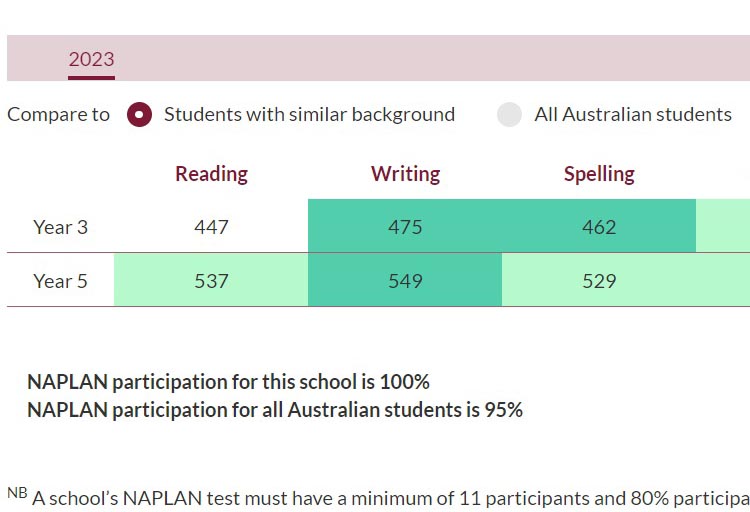
The most recent results, based on 2023 testing, show the school has moved from four to eight of 10 assessment areas above statistically similar schools. This includes results significantly above in writing and spelling.

NAPLAN 2023 writing and spelling results graphic - Holy Spirit Catholic Primary School North RydePrincipal Brian Story said the results reflected the school’s consistent, high-quality teaching practices, and were a result of teachers working in partnership with parents to establish learning goals and meet each child’s learning needs.

Mr Story said students were also well extended through the Newman Selective Gifted Education Program while the QuickSmart program helped to support students who struggle with Mathematics, leading to academic growth.

“These results are evidence of the dedication of our experienced and highly talented staff who strive to ensure that every child achieves at least one year of academic growth for one year of work,” Mr Story said.

“We are extremely proud of our students for the growth they have achieved.”

Holy Spirit will hold open days on Sunday 3 March, 11am – 1pm, and Wednesday 6 March, 9.30am – 11.30am. Register to attend here. WHAT TO LOOK FOR IN A QUALITY GIFTED EDUCATION OFFERING

NAPLAN begins on Tuesday 10 May

MEDIA RELEASE – Issued by Australian Curriculum, Assessment and Reporting Authority (ACARA)

The annual NAPLAN assessment begins tomorrow, with 1.2 million students set to take the test in more than 9,500 schools and campuses across Australia.

This year marks the final year of transition to online testing, with all schools across Australia now participating in NAPLAN tests online.

“NAPLAN online is a better, more precise assessment that is more engaging for students,” ACARA CEO, David de Carvalho, said.

“The tailored testing means students are given questions that are better suited to their abilities, so they can show what they know and can do.

“NAPLAN online also has a variety of accessibility adjustments, so that students with diverse capabilities, learning needs and functional abilities are able to participate.

Mr de Carvalho said NAPLAN was entering a new era, with 2022 being the first year all schools will take the test online and the last year that the test will take place in May.

“Earlier this year, education ministers announced that NAPLAN will move from May to March from 2023, so results will be available to education authorities earlier in the year to inform school and system teaching and learning programs,” said Mr de Carvalho.

“These changes mean that the valuable NAPLAN data will be more useful to teachers, schools and education authorities.”

NAPLAN tests are the only measure governments, education authorities, schools and parents/carers have to see whether young Australians are reaching important literacy and numeracy goals using a national, objective scale.

“This year’s test is particularly important so that we can add to a national data set and continue getting insight into the impact the pandemic has had after 2 years of disruptions to schooling,” Mr de Carvalho said.

“The …

Go to Top