
Everyone seems to be talking about STEAM education, and for good reason.
Many parents will already be familiar with STEM, which brings together Science, Technology, Engineering and Mathematics. STEAM places the Arts more centrally within this learning experience. Both approaches foster creativity, communication, design thinking and problem-solving, and are most powerful when these disciplines are connected rather than explored in isolation.
At Sydney Catholic Schools (SCS), this learning comes to life through opportunities such as SCS STEM MAD, part of the national STEM MAD (Make A Difference) competition. Each September, students across our system develop and share innovative projects that apply their knowledge and creativity to real-world challenges.
More than a competition, STEM MAD encourages students to view the world with empathy and identify ways to support others, care for our environment and make a positive difference. Reflecting Pope Francis’ Laudato Si’ and its call to care for our common home, students discover that their creativity, innovation and STEM skills can be used to develop meaningful solutions and positively impact the world around them.
As Christine McDonald, Education Officer: K-6 (STEM) Curriculum & Innovation at SCS explains, “Importantly, STEM and STEAM don’t have to be confined to the classroom. Families can create authentic learning experiences at home that often look and feel like play, while developing a deeper understanding and appreciation of the world around them.”
Here are a few tips to get you started…
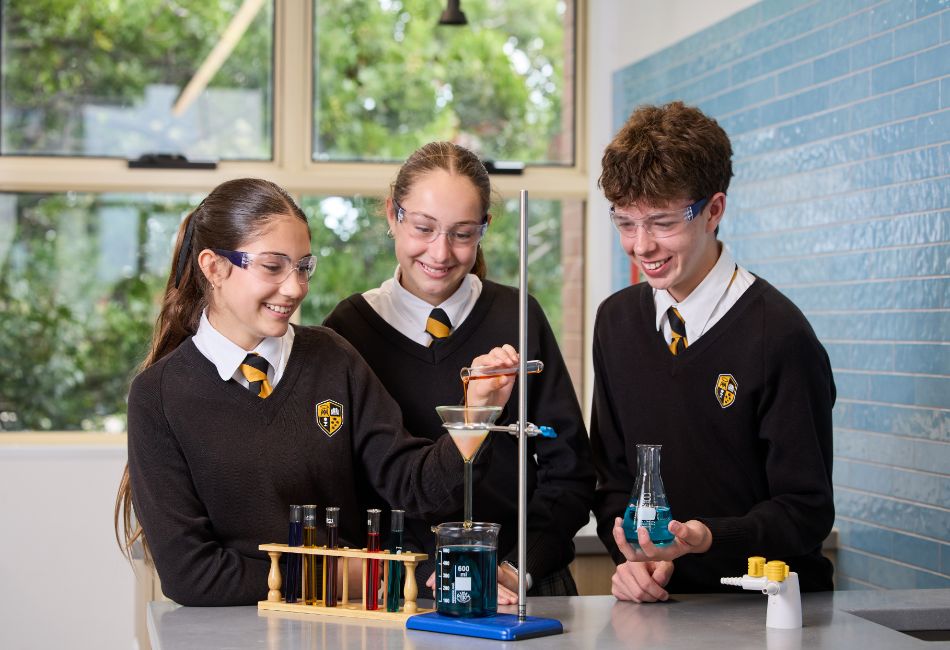
Science: Become a Backyard Investigator
Nature is the perfect outdoor laboratory.
Younger children can create a nature journal, observing insects, birds or plants in the backyard or local park. Older students can investigate biodiversity by identifying native species, tracking weather patterns or testing water quality in local waterways using simple testing kits.
Try this: Visit the same park or garden once a month and record what changes you notice throughout the seasons. Compare your observations over time. Or download the free iNaturalist app to identify plants and animals while contributing to real scientific research.
Technology: Create like a Digital Creator
Technology isn’t just about using devices. It’s about creating with them.
Primary students could produce a stop-motion animation using LEGO, toys or drawings, while secondary students might create a short documentary, design a podcast or learn basic video editing.
These projects develop digital literacy, storytelling and communication skills while encouraging creativity.
Try this: Explore free stop-motion projects with Stop Motion Studio or discover beginner filmmaking ideas on Adobe Express for Education.
Engineering: Take on the Ultimate Paper Challenge
Can you build something extraordinary using only paper and tape?
Challenge children to design a paper aeroplane that flies the furthest, a marble maze, a freestanding tower or a bridge capable of supporting a stack of books.
Older students can test different designs, record results and improve their creations using the engineering design process. By adding a cost to each of the materials used, they could be challenged to build the fastest maze or strongest bridge/tower for a defined cost. As Jacinta Russo, SCS Manager Curriculum and Innovation, explains, “STEAM learning is important because it empowers students to apply knowledge to authentic problems through a cycle of inquiry, design, testing and reflection. Drawing on strong disciplinary foundations, students investigate ideas, develop and refine solutions, and deepen their understanding as they transfer learning to new contexts.”
Try this: Time each design, measure distances or test weight limits before redesigning for even better results.
Arts: Design Like an Architect
STEAM celebrates creativity just as much as scientific thinking.
Invite children to redesign their dream bedroom, a playground or even a sustainable future school. Younger children can sketch their ideas, while older students can create digital floor plans or 3D models using free design software.
This combines creativity with design thinking, spatial awareness and real-world problem solving.
Try this: Explore beginner-friendly design projects using Tinkercad, where students can create simple 3D models online.
Mathematics: Become a Family Data Detective
Maths is everywhere, especially in everyday decisions.
Ask younger children to survey family members about favourite foods, sports or pets and turn the results into colourful graphs.
Older students could compare supermarket prices, calculate the cost of a family holiday, analyse sports statistics or track their daily screen time and present the data visually.
These activities show how Maths helps us make informed decisions every day.
Try this: Use Google Sheets or Microsoft Excel to create charts and discover trends in your data.
Curiosity Starts at Home
At Sydney Catholic Schools, we believe learning is about much more than remembering facts. It's about inspiring wonder through curiosity, building wisdom through discovery and critical thinking, and empowering students to be a positive witness in the world by using their knowledge with confidence and purpose.
Jacinta adds, "Parents can support STEAM learning by encouraging curiosity, exploring ideas together and celebrating effort, perseverance and problem-solving. The most powerful learning often begins with a simple question: 'I wonder why?'"
By encouraging children to experiment, design, create and investigate at home, you're helping them build the curiosity, resilience and critical thinking skills they'll use throughout their education—and beyond.
Cultivating wonder, wisdom and witness, Sydney Catholic Schools form the whole child through excellence in learning, faith, vocation, sport and the arts.