(function(w,d,s,l,i){w[l]=w[l]||[];w[l].push({'gtm.start': new Date().getTime(),event:'gtm.js'});var f=d.getElementsByTagName(s)[0], j=d.createElement(s),dl=l!='dataLayer'?'&l='+l:'';j.async=true;j.data-privacy-src= 'https://www.googletagmanager.com/gtm.js?id='+i+dl;f.parentNode.insertBefore(j,f); })(window,document,'script','dataLayer','GTM-MF9T2HG');

Surfing for her mob, caring for her community

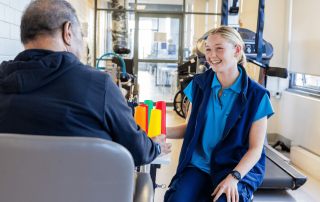
As National Reconciliation Week draws to a close, St Aloysius College Cronulla student Matilda Thearle has made history as the first Allied Health school-based Aboriginal trainee at Sydney Local Health District. 

The Year 12 student is completing a Certificate III in Allied Health Assistance through placements at Balmain Hospital and Forest Lodge Child and Family Health Centre, gaining hands-on experience across a range of health disciplines. 

The traineeship has seen Matilda named a finalist in the Aboriginal and Torres Strait Islander Student of the Year category at the 2026 NSW Training Awards, with winners announced on 4 June. 

“It’s just so rewarding to be able to help patients get back to doing daily activities and to see them gain confidence,” Matilda said. “My plan is to continue doing Allied Health Assistance as a job when I finish school.” 

A proud Badjiri woman whose family ties trace back to Cunnamulla in south-west Queensland, Matilda also travelled to Victoria last weekend to compete at the Australian Indigenous Surf Titles at Bells Beach, placing fourth in the Open Women’s division. 

“I feel really proud that I can represent at such a high level, not only as an athlete but also as a proud young Aboriginal woman,” she said. 

For Matilda, Indigenous sporting events are about far more than competition. Through them she has built friendships, strengthened her connection to culture and gained a deeper understanding of Aboriginal communities across Australia.  

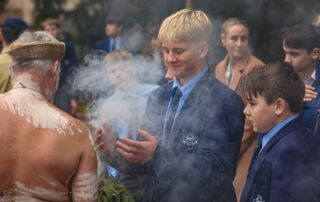
Participating in smoking ceremonies before competitions connects her to the land and waterways where she surfs. 

Away from competition, she also coaches surfers of all ages at Cronulla Surfing Academy. 

Yvette Kennedy, Instructional Leader Pathways and Partnerships at St Aloysius College said Matilda had shaped her educational journey with real purpose.  

“She has taken ownership of …
Honouring their service and sacrifice: SCS commemorates Aboriginal and Torres Strait Islander veterans

In 1942, Leonard ‘Len’ Waters, a proud Kamilaroi (Gamilaraay) man, found himself at the crossroads of history as Japan entered World War II, with the threat of invasion looming ever closer to Australian shores.

Responding to the urgent call of the Royal Australian Air Force (RAAF) for recruits, Waters and his brother, Jim, volunteered for service at No. 3 Recruiting Centre in Brisbane in August 1942.

Undeterred by his limited formal education, Waters began training as a pilot in 1943, determined to prove himself. By July 1944, his hard work paid off as he received his RAAF pilot’s wings and was promoted to sergeant, becoming Australia’s first-ever Indigenous fighter pilot.

Waters flew an impressive 95 missions in his Kittyhawk, Black Magic, logging 103 flying hours. After the war, he left the Air Force, married his fiancée, and returned to shearing, never to fly again.

In a heartfelt tribute to the bravery of individuals like Waters, students from across Sydney Catholic Schools (SCS) gathered at the Anzac Memorial in Hyde Park to honour the service and sacrifice of Aboriginal and Torres Strait Islander veterans.

Through our Goodjarga Aboriginal and Torres Strait Performing Arts program, more than 50 Aboriginal students from six schools represented SCS, delivering a moving rendition of the National Anthem in both Dharawal and English. 

A further six students from St Mary’s Cathedral College Sydney embraced the prestigious role of flag bearers for the ceremony, selected for their outstanding dedication and leadership within their school community.

This year, 18 Sydney Catholic Schools attended the ceremony, each laying a beautiful wreath at the Hyde Park Pool of Reflection to honour the service of First Nations’ men and women, both past and present.

SCS Supervisor for …

Being a voice for Reconciliation

I write this piece on the land of the Gadigal people of the Eora Nation who are part of a rich aboriginal culture that has existed continuously in Australia for at least 65,000 years.

It’s widely accepted that this predates the modern human settlement of Europe and the Americas.

To put this into perspective, European settlement of Australia occurred in 1788 – just 235 years ago.

Most Australians have families who arrived in Australia a long time after 1788.

As much as we love Australia, its land, its people and all the opportunities it’s given us, most of us have a very limited connection to Australia’s Aboriginal and Torres Strait Islander peoples and their culture.

Reconciliation starts by asking why we are far more likely to be aware of American or European history than the history of our first nations peoples?

Why are we far more likely to know a few words of Italian, French, Spanish or Japanese than to say hello or goodbye in any one of the hundreds of Aboriginal languages?

And why we have perhaps struggled to understand what it was like to live in Australia not so long ago when swimming pools, buses and cinemas were segregated on the basis of whether or not you were an Aboriginal or Torres Strait Islander person?

Reconciliation starts in acknowledging that Aboriginal and Torres Strait Islander children were forcibly removed from their families and sent to orphanages – a generational trauma that continues to this day.

In acknowledging that Aboriginal and Torres Strait Islander peoples were not constitutionally recognised until the late 1960s.

And acknowledging that it was not until 1992 that the High Court finally established under Australian law that Australia was …

SCS launches new Reconciliation Action Plan

Sydney Catholic Schools (SCS) came together as a community this week to recognise National Reconciliation Week and to introduce the Catholic Archdiocese of Sydney’s new Reflect Reconciliation Action Plan (RAP).

The theme for National Reconciliation Week 2023, Be a Voice for Generations, encourages all Australians to be a voice for reconciliation in tangible ways in our everyday lives—where we live, work and socialise.

On Wednesday, SCS gathered in World Square to reflect on how to proactively bring about meaningful change in society, and together help create a more just and equitable Australia.

The gathering was led by Jane Bridges, SCS Supervisor: Student Wellbeing Aboriginal & Torres Strait Islander, and featured performances by SCS Indigenous artist-in-residence, Hamani Tanginoa.

The day was also an opportunity to speak about the Catholic Archdiocese of Sydney’s new Reflect RAP.

As a key organisation within the Archdiocese, Sydney Catholic Schools is committed to positively and innovatively delivering the RAP

The Reflect RAP will help guide our parishes, schools and importantly our students to contribute to reconciliation, and promote ways in which we acknowledge and celebrate Aboriginal and Torres Strait Islander peoples’ cultures and relationships to Country.

Based around the core pillars of relationships, respect and opportunities, RAPs have the capacity to contribute to tangible and substantive benefits for Aboriginal and Torres Strait Islander peoples, increasing economic equity and supporting First Nations self-determination.

To celebrate the RAP, Indigenous artists Evis Heath and Richard Campbell collaborated on the creation of a one-off, original piece.

Coming Together, To Gather as One incorporates both Australia’s Ancient Land and the Christian story, and depicts forging a path towards Reconciliation.

The artwork incorporates …

National Reconciliation Week: Wandana mural unveiled

Marist College Eastwood students have marked National Reconciliation Week and the rich history of their school and suburb with a painting that will last for generations to come.

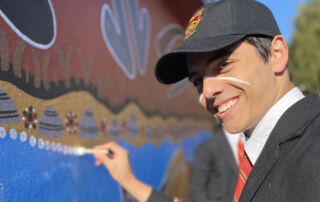
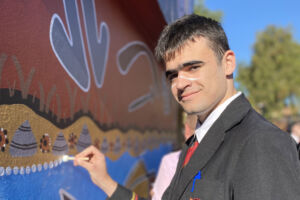
The mural, painted with Indigenous artists Deslyn Marsh and Isaac Bamblett from Aboriginal education provider Wandana, features red oxide circles and four yellow travel routes to represent the four name changes the school has been through.

Other symbols on the mural show the land and bush tucker that sustained the local Wallumettegal tribe.

“Students gained a better understanding of the local land and Aboriginal customs, as well as an appreciation for the work that can be achieved when we come together as a community” – Silvana Rossetti

A Marist College Eastwood male students helps create an Indigenous mural with Wandana artists“It has been wonderful to learn about the original inhabitants of this land and to learn that a fish – snapper – was the totem of the Aboriginal people living on this land,” Marist College Eastwood Principal, Silvana Rossetti, said.

“The fish is also a powerful symbol for Christians, so it is a beautiful reminder for us of both Aboriginal and Christian spirituality.”

Mrs Rossetti said the mural was a way to raise awareness of Aboriginal culture and was situated in an area that was highly visible to the school’s staff, students and visitors.

“We are proud to be able to acknowledge not only the history of the school, which began in 1937, but also the land upon which it is built,” she said. Support for our Indigenous students

Go to Top