(function(w,d,s,l,i){w[l]=w[l]||[];w[l].push({'gtm.start': new Date().getTime(),event:'gtm.js'});var f=d.getElementsByTagName(s)[0], j=d.createElement(s),dl=l!='dataLayer'?'&l='+l:'';j.async=true;j.data-privacy-src= 'https://www.googletagmanager.com/gtm.js?id='+i+dl;f.parentNode.insertBefore(j,f); })(window,document,'script','dataLayer','GTM-MF9T2HG');

Cracking the code: Four ways to make Mathematics fun for your child

Mathematics—it’s everywhere! From counting pocket money to measuring ingredients for the perfect batch of cookies, numbers are a part of our daily lives in ways we don’t always notice. But for some kids, Mathematics feels like a puzzle with missing pieces. The good news? With a little creativity, you can help your child—no matter their age—see beyond just numbers on a page.

Here are four fun and easy ways to make Mathematics a little less “ugh” and a lot more “aha!”
1. Turn play into learning

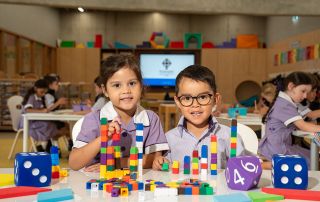
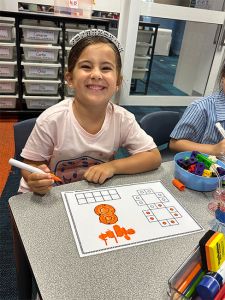
Let’s be real—kids love to play! And the best part? They can build Mathematics skills while they’re at it. Board games, card games and even simple dice games teach counting and strategy, puzzles strengthen spatial reasoning, and everyday objects from buttons to blueberries allow them to explore counting, sorting and basic arithmetic. Even simple activities like stacking blocks to explore patterns and symmetry can spark curiosity.

2. Storytelling and Mathematical mysteries

Stories are a wonderful gateway to imagination, and within their pages, mathematics thrives. From the simple rhythms of days of the week to the intricate logic of young detective novels, mathematical concepts are woven into the very fabric of narrative. Whether it’s measuring ingredients for a wizard’s potion or counting a dragon’s hoard of gold, weaving maths into stories transforms learning into an exciting part of the adventure.

3. Make it real

In the day-to-day, Mathematics is never far away. Keeping score in a game? That’s arithmetic 101. Comparing prices while shopping? That’s budgeting and cost analysis. Even checking the time or planning a trip involves Mathematics. For older kids, seeing how it plays a role in careers like engineering, medicine, and technology can also be a real eye-opener. Greg Georgiou, Mathematics & …
How to make Mathematics fun for kids

Mathematics skills are vital to help children make sense of the world.

So how do you ensure they learn and enjoy them?

Here we look at how schools set strong numeracy foundations from Kindergarten, and the activities you can do at home to help your child’s skill, confidence, and appreciation for Maths grow.

Strong foundations

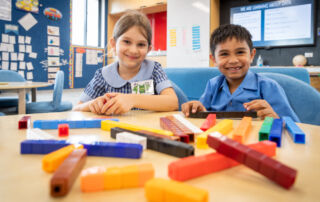
At Sydney Catholic Schools, students in Kindergarten to Year 2 are explicitly taught Mathematics through active learning experiences that link to real-world scenarios.

Numeracy and Mathematics Specialist at Sydney Catholic Schools, Greg Georgiou, said this allows students to practise and apply their knowledge to different situations.

“The role and intent of a Kindergarten Mathematics lesson is for students to develop essential numeracy skills and fluency, while nurturing the ability to think logically, critically and creatively,” he said.

Education Officer: Curriculum (K-6 Mathematics) Maree Cooper agrees. She said Kindergarten children require a lot of practice and active exploration with everyday objects to confidently develop numeracy and Mathematics skills.

“Teachers provide ample time, materials, and high-quality targeted support for children to enhance core skills like matching, sorting, comparing and ordering,” Mrs Cooper said.

“A Kindergarten Mathematics lesson [develops] essential numeracy skills and fluency, while nurturing the ability to think logically, critically and creatively.” – Greg Georgiou, numeracy and Mathematics specialist

The language of Mathematics

Developing a vocabulary specific to Maths at home also helps students thrive in the subject.

Words like high, low, short, long, light, heavy, near, far, first, and last make the list to describe distance, order, and other key concepts.

Your child might also compare quantities using phrases like ‘more than’, ‘less than’ or ‘the same as’. 

“It might take time for your child to use …

Adding fun and opportunities to primary Maths

A challenge program at Patrician Brothers’ College Fairfield is giving gifted Mathematics primary school students a chance to expand their problem-solving and number skills.

It is the second year that the college has run its Maths Challenge. 

Sixteen students from the following three College feeder primary schools took part in the 2022 program: 

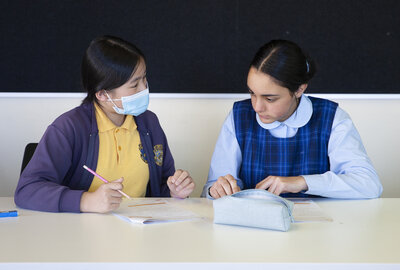
Sydney Catholic Schools students work on a maths problem together

“The purpose of the program is to both excite and challenge the students’ knowledge about what it means to apply and use mathematics,” said Patrician Brothers’ Mathematics teacher and program facilitator, Peter Pham.

He said the challenge was designed to meet a need for extension opportunities in the primary school setting.

“It extends the students who have demonstrated the capacity to work up to three years ahead of their peers,” Mr Pham said.

“Rather than it being something tedious and repetitive, we wanted to show students that you can apply Mathematics to different situations” Peter Pham

About the Maths Challenge

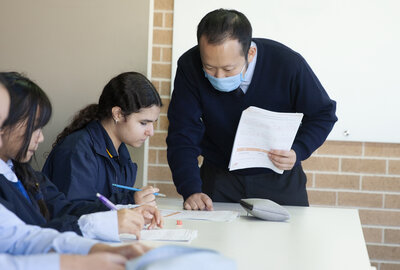
A Sydney Catholic Schools student learning maths in class

The Thursday sessions include a teaser question for the primary students, which is followed up with a problem for them to solve covering topics such as algebra, measurement, area, perimeter, indices, probability, and data analysis and evaluation.

“I give them time to attempt to solve the question themselves before providing guidance and going through solutions,” Mr Pham said.

“We want to develop a culture where …

Accolades keep adding up

Who hasn’t seen a kindergartener with a backpack so big it’s almost dragging on the ground.

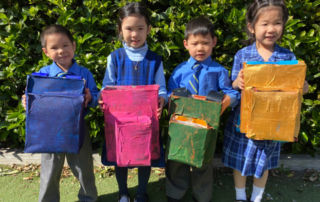
Four kindies at Our Lady of the Rosary Catholic Primary School Fairfield have taken matters into their own hands and designed and then made a 3-D model of a school bag that’s much easier on their little backs.

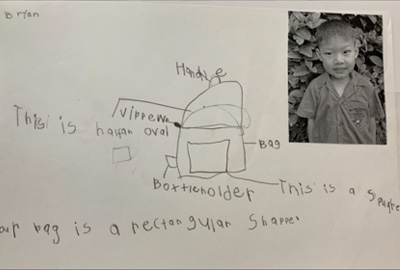
Our Lady of the Rosary Fairfield student Bryan Yeung’s impressive 2-D school bag design Kindy student Bryan Yeung’s impressive 2-D school bag design.
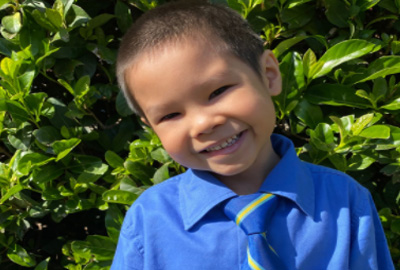
Cindy Wang, Bryan Yeung, Chandler Tran and Hannah Ly were among four teams from Our Lady who have wowed the judges of a prestigious mathematical competition with their ingenuity.

The Investigating with Mathematics Competition, run by the Mathematical Association of NSW (MANSW), asks students in Kindergarten to Year 12 to come up with a solution to a real-life problem using maths.

Teams in Kindergarten, Year 1, Year 2 and Year 6 at Our Lady placed first in the state competition and then Kindergarten and Year 1 went on to come first in Australia, with Year 2 and 6 receiving Highly Commended Awards.

“We are very proud of our students and teachers,” school principal, Jackie Vella, said.

Bryan and Hannah said winning made them “happy.”

Dr Christine Mae, Sydney Catholic Schools’ (SCS) K-12 Mathematics and Numeracy Education Officer, said: “It is exciting to see that we have such young minds engaging in high levels of challenge by investigating real-world problems in and around the school.”

Our Lady of the Rosary Fairfield kindy student, Chandler Tran “I’m the smartest in the family,” claims kindy student, Chandler Tran. “I’ve learnt how to count up to septillion!”

WHAT THEY INVESTIGATED

Kindergarten
Using a 2-D plan, Cindy Wang, Bryan Yeung, Chandler Tran and Hannah Ly …

October 12, 2020|
Go to Top