(function(w,d,s,l,i){w[l]=w[l]||[];w[l].push({'gtm.start': new Date().getTime(),event:'gtm.js'});var f=d.getElementsByTagName(s)[0], j=d.createElement(s),dl=l!='dataLayer'?'&l='+l:'';j.async=true;j.data-privacy-src= 'https://www.googletagmanager.com/gtm.js?id='+i+dl;f.parentNode.insertBefore(j,f); })(window,document,'script','dataLayer','GTM-MF9T2HG');

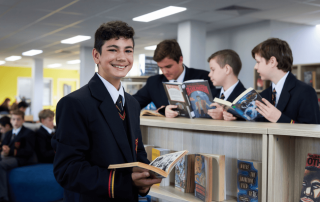
From scrolling to stories: Four ways to help teens fall in love with reading again

In today’s world of endless social media feeds, streaming services, and constant notifications, it’s easy for teenagers to forget the simple joy of getting lost in a good book. Nurturing a love of reading doesn’t have to be a chore, it can be a delightful journey back to wonder, imagination, and even faith.

If you’re a parent or guardian looking to gently reignite that spark, here are four practical ways to help your child rediscover the magic of reading.

Along for this literary ride are our resident Sydney Catholic Schools experts, Curriculum and Innovation Specialists Jacqueline Simpson and Adam Moore, who offer practical, research-informed insights into how teens engage with stories today.

Start with what they already love

Books don’t have to be classics or New York Times bestsellers to spark interest. If your teen is into Marvel, Minecraft, or The Mandalorian, there’s likely a novel, comic, or companion book to match.

“Reading for pleasure often dips in the teenage years, but that doesn’t necessarily mean teens aren’t reading, perhaps just differently,” explains Adam.

By tapping into pop culture, parents can help turn “I don’t like reading” into “Wait, there’s a book about that?”

📚 Recommended reads:

  • Star Wars: Ahsoka by E.K. Johnston – Fills in the story between the Clone Wars and Rebels with strong themes of courage, identity, and justice.
  • Minecraft: The Island by Max Brooks – A survival adventure written in a fun, accessible style that mirrors the game’s challenges.
  • Halo: The Fall of Reach by Eric Nylund – A deeper …

English HSC: How to write a cracking Module C Part B

To help you out, here are some handy tips for a specific component of the English HSC exam: the Module C Part B question. 

The Module C Part B question requires you to reflect upon your own work and to demonstrate what you have learnt about the craft of writing. 

This guide is drawn from Sydney Catholic Schools’ Masterclasses series, which offers 38 sessions across 15 HSC subjects.  

What is Module C Part B?

  • Module C forms part of Paper 2 – it is worth 20 marks and you are advised to allocate 40 minutes to this section
  • It will either consist of a one- or two-part question, however there is no guarantee of a Part B question (the 2020 paper did not have a Part B, but the 2019 paper did) 
  • Part B requires you to explain and justify the choices you made in your writing in Part A
  • You may be required to demonstrate how your writing links to at least one of the prescribed texts that you have studied as part of your Craft of Writing course

What is the purpose of Module C Part B?

The purpose is to demonstrate:

  • Your appreciation of the impact your reading of the model texts has had on your own writing 
  • Your confidence in your own writing and your ability to craft writing to the demands of the question
  • Your appreciation of, and engagement with, your own writing 
  • Your ability to make connections between your own writing and that of the models

What might a Part B question …

Go to Top